
We built a better blockchainOur payment rail runs on it
Zero Fraud Changes Everything
Every fee in the current system exists, at least in part, to price in fraud. The interchange margin. The reserve. The chargeback buffer. Remove fraud from the architecture and the entire pricing model shifts.
Issuers lend with confidence they've never had. Merchants keep more of every sale. Consumers access credit priced for a world where their account can't be weaponized against them. The rail doesn't just move money differently. It changes what money costs.
QNulla is a permissioned blockchain payment network where financial institutions issue credit, merchants accept it, and consumers spend it like a credit card. Fraud has no mechanism to operate. Not reduced. Not managed. Architecturally impossible. Built for the real world, not speculation.
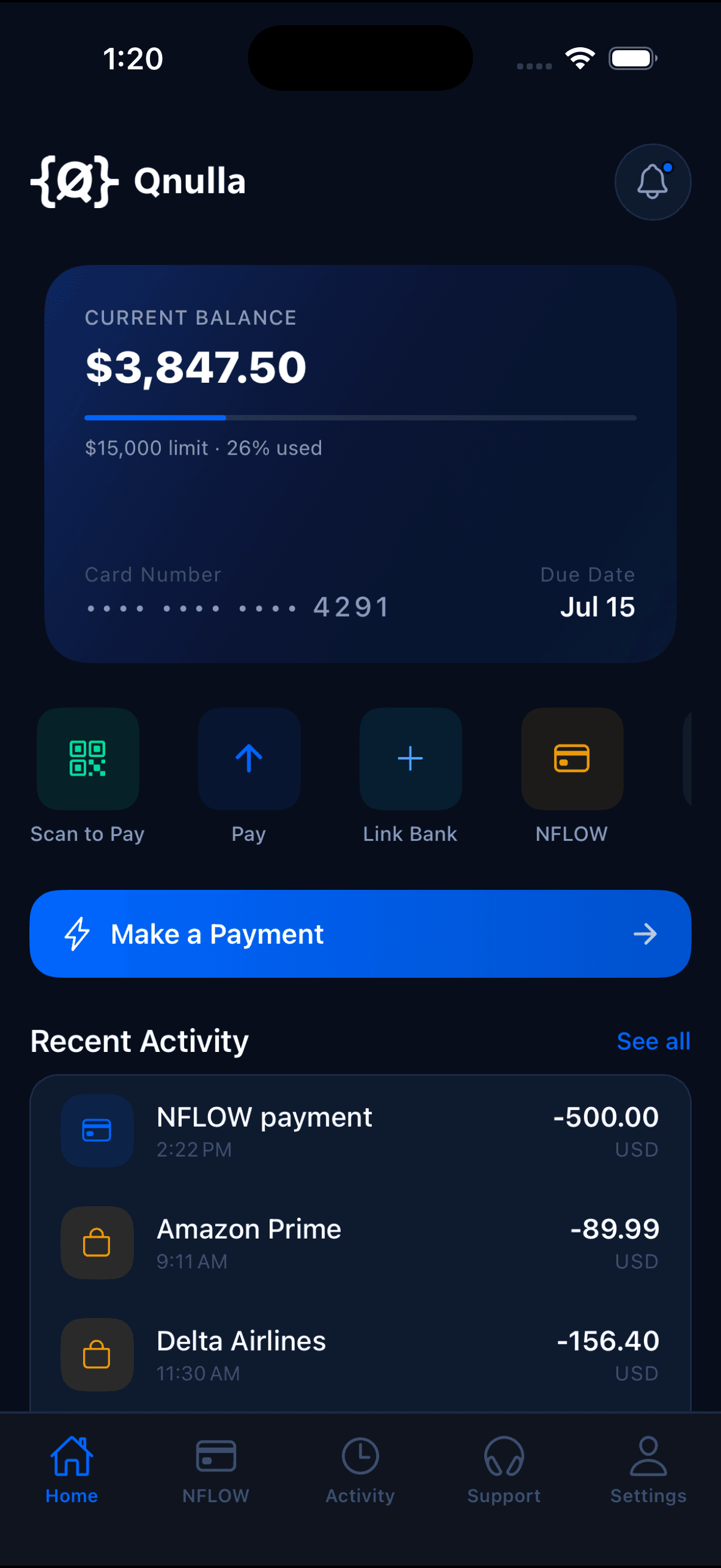
What We Built
The Problem
Visa and Mastercard charge 150 to 350 basis points on every transaction. They always have. Merchants absorb it, pass it on, or both. On top of that, roughly $40 billion in friendly fraud moves through a system with no structural way to stop it. The payment rail was never designed to stop it. It just processes whatever it's told. The basis point fee is the rent.
We built something different.
Permissioned Blockchain Rail
Public chains cannot carry commercial payment data. QNulla owns the rail entirely. Financial institutions, merchants, and consumers each have defined, verified roles. Same cryptographic guarantees as any public chain. None of the exposure.
Zero Fraud
Every transaction is cryptographically signed and block-confirmed on an immutable chain. Friendly fraud has nothing to dispute. Nefarious fraud has no viable attack surface. Not a detection system. The mechanism itself does not exist.
Post-Quantum from Day One
Every transaction signature uses ML-DSA-65 (FIPS 204), the NIST-standardized post-quantum scheme finalized in 2024. Not a planned upgrade. The foundation. Quantum computing is architecturally irrelevant to QNulla by design.
Institutional-Grade Compliance Built In
Five-step KYC via Sumsub, AML screening, and OFAC sanctions matching embedded in onboarding. Every participant verified before they transact. Every issuer partner inherits a solved compliance problem, not an open one.
The Evolution of QNulla
The Root
BarterPay. Where QNulla began. A live payment gateway built on an IRS-recognized barter framework that structurally reduces chargebacks and friendly fraud. The proof the architecture works.
The Bridge
Real-time settlement. ACH and wire at T+0, Visa-validated. The layer that connects the legacy financial world to what QNulla is building. Already proven. Banking partner pending.
The Rail
QFLOW. The full credit rail. Financial institutions issue, merchants accept, consumers spend. Every repayment drives demand back into the network. This is where the system completes itself.
Payment Rail
1% fee on every transaction settled through the QNulla network.
Platform Authorization
Fee to onboard third-party projects and institutions onto the blockchain.
Issuer Lending Capacity
QNulla operates on the proven 10:1 lending model. Every dollar deposited on the rail creates ten dollars of productive credit capacity. Built into the architecture from day one.
The window is open.
Securitize just IPO'd at $295M. BlackRock, JPMorgan, NYSE, and DTCC are all moving to on-chain settlement now. The infrastructure build is underway. QNulla is built for where this lands. Every other blockchain is not.
The Architecture
Every public-chain player: Securitize, Ethereum, Solana, is running the same race. Better encryption, more validators, higher walls. That's a permanent, escalating cost with no finish line. Quantum computing eventually wins it.
We asked a different question. The Tail Protocol didn't ask how to stop attackers. It asked why they'd bother. Remove the reward and you don't need infinitely higher walls. That's not a security feature. It's a different philosophy of system design.
The permissioned layer handles the rest. On Ethereum or Solana, anyone can deploy anything, including the attack vectors. On QNulla, that surface doesn't exist without our permission. We built on ML-DSA-65 (FIPS 204) post-quantum cryptography from day one. Not as a planned upgrade. As the foundation.
Every project we allow on the chain inherits the same architecture. That's the point.
Consensus
HotStuff BFT consensus engine. 6-second block finality.
Cryptography
ML-DSA-65 post-quantum signatures. SHA3-256 block fingerprinting.
Test Coverage
580 automated tests passing. 500,000+ test transactions run under CTO supervision.
POS Integrations
Live adapters for Square, Stripe Terminal, Clover, Toast, and Lightspeed.
Compliance
KYC via Sumsub (5-step), AML screening, OFAC sanctions matching. Built in, not bolted on.
Chain Status
75K+ blocks complete. Permissioned mainnet architecture operational.